

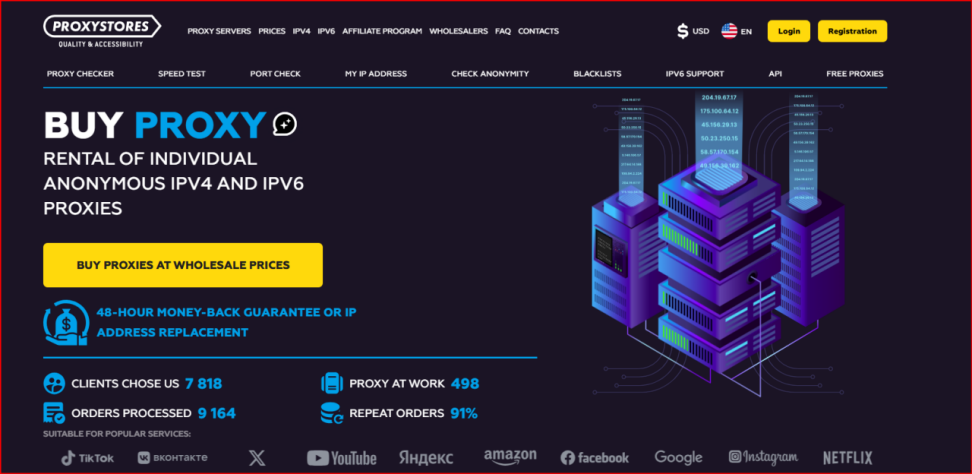
I reviewed ProxyStores with a jobs-to-be-done framework. Buyers rarely wake up wanting “an IPv4 proxy” as an end in itself. They want to check a local search result, verify a regional page, keep a fixed automation worker online, test an ecommerce flow, or run a Telegram-oriented connection. The useful review question is therefore not which product sounds best, but which product removes the least friction from the actual job.
ProxyStores sells Shared IPv4, Individual IPv4, IPv6/32 and MTProto products, with short and longer rental periods. The provider also presents diagnostic tools, location selection options and account features similar to the broader fixed-proxy category. In this review I map those products to five common jobs, then evaluate setup, pricing, protocol fit, location accuracy, team management, replacement and buyer risk.
| Jobs-to-be-done rule Do not ask “which proxy is best?” Ask “what job must this endpoint complete, how persistent is the identity, how sensitive is the target, and what failure can the workflow tolerate?” |
The product menu and pricing snapshot
The current ProxyStores pricing page separates the main proxy families by product, quantity and rental period.
| Product | Qty | 5 days | 30 days | 90 days | 360 days |
| IPv4 Shared | 1-20 IPs | $0.67 | $0.99 | $2.97 | $11.88 |
| Individual IPv4 | 1-20 IPs | $0.96 | $1.77 | $5.31 | $21.24 |
| Individual IPv4 | 21-40 IPs | $0.91 | $1.74 | $5.22 | $20.88 |
| Individual IPv4 | 41-89 IPs | $0.89 | $1.56 | $4.68 | $18.72 |
| Individual IPv4 | 90-1000 IPs | $0.83 | $1.50 | $4.50 | $18.00 |
| IPv6/32 | 1-99 IPs | $0.10 | $0.51 | $1.53 | $6.12 |
| IPv6/32 | 100-199 IPs | $0.10 | $0.48 | $1.44 | $5.76 |
| IPv6/32 | 200-3000 IPs | $0.09 | $0.48 | $1.44 | $5.76 |
| MTProto | 1-20 IPs | $0.96 | $1.77 | $5.31 | $21.24 |
The table shows why product selection matters more than headline price. IPv6 is inexpensive, but compatibility can be limited. Shared IPv4 lowers cost but introduces simultaneous-use uncertainty. Individual IPv4 costs more but is easier to own operationally. MTProto is specialized. A buyer should therefore start from the job and work backward to the product lane.
Job 1 – local SEO and regional search checks
The core requirement is accurate regional presentation rather than long-lived account identity. I would start with the lowest-cost IPv4 option that reliably maps to the required country or city, then validate the result on the actual search engine or local page. Shared IPv4 can be sufficient for public SERP checks because occasional reputation variance is often tolerable. Individual IPv4 becomes more attractive when the same endpoint is used repeatedly by a scheduled rank-tracking worker and consistency matters more than minimum price.
The operational record should include query, location, endpoint and timestamp. Search results change naturally, so a team must distinguish content changes from proxy changes. If the apparent ranking shifts after a proxy replacement, the record makes it possible to compare like with like.
Job 2 – website localization and checkout QA
Localization QA needs the destination to show the correct language, currency, tax treatment, shipping options or availability rules. Here I would prioritize accurate location and clean repeatability. The proxy should be attached to a test case so the QA team knows which region produced which screenshot. Individual IPv4 is easier to keep consistent over a multi-day test cycle, while Shared IPv4 can be acceptable for one-off public checks.
A proxy is only one variable in localization. Browser language, cookies, account country, device settings and stored location data can also influence the page. The QA plan should therefore use a clean profile and record the non-proxy variables. Otherwise the team may blame the network address for a result caused by the browser or account.
Job 3 – recurring automation
Automation changes the risk profile because the endpoint may be reused every hour or every day. I prefer Individual IPv4 for recurring workers because the ownership model is clearer and simultaneous sharing is removed during the rental period. The automation should classify failures into network errors, authentication errors, target blocks and application bugs. Without error classification, the system may replace good proxies or retry bad jobs indefinitely.
| Automation control | Recommended practice | Reason |
| Timeouts | Explicit connect/read limits | Prevents hung workers |
| Retries | Bounded + backoff | Avoids request storms |
| Assignment | One endpoint per persistent worker where needed | Keeps identity understandable |
| Logging | Endpoint + target + status | Supports root-cause analysis |
| Replacement | Evidence-based threshold | Avoids needless rotation |
Job 4 – Telegram and MTProto
MTProto should be selected when the job specifically requires Telegram-oriented proxying. That is a different job from general HTTP browsing, SEO checking or a SOCKS5-capable desktop application. The presence of an MTProto product is useful because it lets the buyer avoid forcing a general-purpose proxy into a specialized protocol role. I would still test the exact Telegram client and network environment before committing to a long term.
Job 5 – e-commerce monitoring and market research
E-commerce work often mixes public catalog checks with more sensitive account or checkout flows. I would separate those tasks rather than forcing one proxy strategy onto all of them. Shared IPv4 may be enough for public price and availability research. Individual IPv4 is more appropriate when a fixed endpoint is deliberately tied to a recurring workspace. For checkout QA, the team should test with authorized accounts and avoid using the proxy as a substitute for marketplace policy compliance.
The decision matrix
| Job | Likely starting product | Why | Main check |
| Local SEO | Shared or Individual IPv4 | Geo visibility + repeatability | Real search result |
| Localization QA | Individual IPv4 for recurring cycles | Stable regional test point | Language/currency/tax |
| Automation | Individual IPv4 | Clear persistent ownership | Retries + target acceptance |
| Telegram | MTProto | Protocol-specific fit | Client compatibility |
| Public catalog research | Shared IPv4 | Lower cost for public pages | Reputation tolerance |
| IPv6-compatible testing | IPv6/32 | Excellent address economics | End-to-end IPv6 support |
Setup and team workflow
Regardless of job, I would store the endpoint in a controlled inventory with an internal label, assignment, region, protocol, purchase date, expiry and status. Credentials should be kept in a password manager or secret store, not pasted into project boards. A short acceptance test should happen before the endpoint is handed to a client or automated process. If the team later changes the proxy, the reason and replacement date should be recorded.
Where buyers make mistakes
- Choosing IPv6 because it is cheap before confirming compatibility.
- Using Shared IPv4 for a workflow that really needs exclusive persistent ownership.
- Treating a country label as proof of destination-level geolocation.
- Rotating proxies after every single CAPTCHA instead of diagnosing the pattern.
- Letting one endpoint drift across several browser profiles with no ownership record.
- Buying a long term before the real target has been tested.
| Strengths | Limitations / checks |
| Product menu covers Shared IPv4, Individual IPv4, IPv6 and MTProtoShort rental term supports low-risk job testingPricing supports small orders and larger quantitiesFixed endpoints are simple to map to recurring tasksSpecialized MTProto lane avoids protocol mismatchUseful for a broad set of public research and QA workflows | No product can guarantee acceptance on every destinationShared IPv4 can inherit reputation varianceIPv6 remains compatibility dependentJob separation and inventory discipline are customer responsibilitiesGeo labels need independent validationAccount-sensitive workflows still need platform-policy compliance |
Jobs-to-be-done verdict
ProxyStores is easiest to buy when the team writes the job first and chooses the proxy second. That approach avoids paying for exclusivity where it adds little value and avoids saving a few cents where operational control matters more. Before ordering, confirm current locations, stock and checkout terms on the official English ProxyStores website. A good proxy purchase is not the product with the longest feature list; it is the one that completes the intended job with the least operational friction.
FAQ
Which ProxyStores product should I start with?
Start from the job: public research can tolerate Shared IPv4, while persistent workflows often benefit from Individual IPv4.
When is IPv6 attractive?
When the client, network path and target all support it and address cost matters.
Why does MTProto have its own category?
Because it is designed for Telegram-oriented proxying rather than general HTTP browsing.
Do I need one proxy per account or job?
Only when the workflow intentionally requires persistent separation. Document the reason rather than applying a blanket rule.
What is the most important pre-purchase test?
Run the real target in the real client and confirm the required location and behavior.