

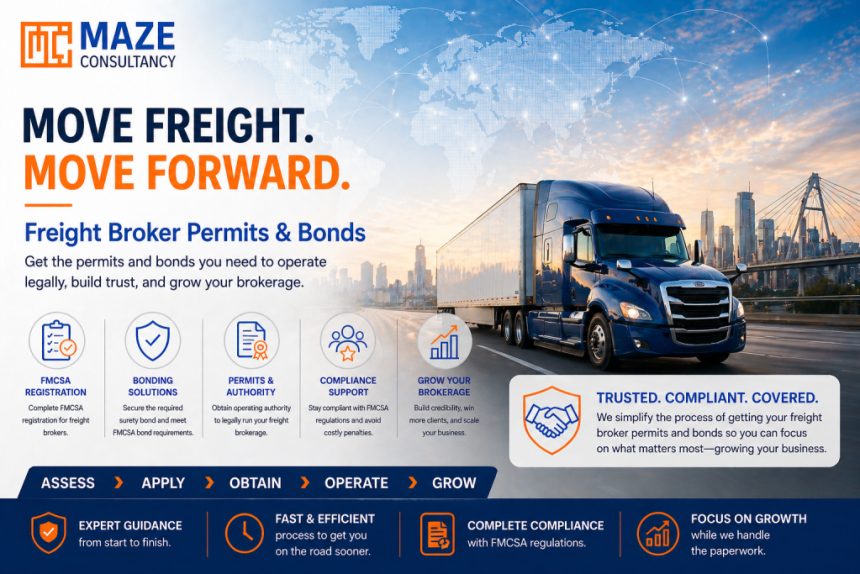
The U.S. freight brokerage industry moves hundreds of billions of dollars in cargo every year. Behind every shipment that a freight broker arranges sits a legal and financial obligation that most people outside the industry never think about: a $75,000 surety bond that every licensed freight broker in the country is required to carry.
For anyone entering the trucking and logistics space as a freight broker, an NVOCC, or a bonded carrier, this bond is not optional and it is not small. Understanding what it covers, what it costs, and why the federal government requires it at this specific amount is genuinely useful background before you start the licensing process.
What a Freight Broker Bond Is
A freight broker bond, formally called a BMC-84 bond, is a federal surety bond required by the Federal Motor Carrier Safety Administration as a condition of receiving a freight broker operating license. Every licensed property broker operating in interstate commerce must carry one continuously.
The bond protects motor carriers and shippers. If a freight broker fails to pay a carrier for completed freight services, or defrauds a shipper in some other way, a claim can be filed against the bond. The surety investigates and pays valid claims up to the $75,000 limit, then seeks reimbursement from the broker.
The $75,000 requirement went into effect in 2013, raised from the prior $10,000 threshold by the Moving Ahead for Progress in the 21st Century Act. The increase reflected how dramatically the industry had grown and how inadequate the old amount had become as real protection for carriers dealing with broker payment defaults.
The Alternative: BMC-85 Trust Fund
There are two ways to satisfy the federal financial security requirement. The BMC-84 surety bond is the more common path, but brokers can alternatively file a BMC-85 trust fund agreement, where they deposit $75,000 in cash or qualifying assets with a trust company that is registered with FMCSA.
Most brokers use the surety bond route because it requires only an annual premium rather than tying up $75,000 in capital. The trust fund option is more common among larger, well-capitalized brokers for whom locking up that cash makes financial sense given the premium savings over time.
| BMC-84 Surety Bond | BMC-85 Trust Fund | |
| Capital required | Annual premium only (1% to 5% of $75K) | $75,000 deposited upfront |
| Annual cost (good credit) | $750 to $2,250 | $0 after initial deposit (but capital is tied up) |
| Best for | New brokers and growing operators | Established brokers with strong cash position |
| Claim process | Surety investigates and pays; seeks reimbursement | Trust pays claims directly from deposited funds |
What the Bond Actually Costs in 2026
At a $75,000 required amount, the freight broker bond is one of the larger license bonds in the transportation space. Premium rates are determined primarily by personal credit score, since the underwriter is assessing the probability that the broker will generate unpaid carrier claims.
| Credit Score | Typical Rate | Annual Premium on $75,000 Bond |
| 720 and above | 1% to 2% | $750 to $1,500 per year |
| 680 to 719 | 2% to 3% | $1,500 to $2,250 per year |
| 640 to 679 | 3% to 5% | $2,250 to $3,750 per year |
| 600 to 639 | 5% to 10% | $3,750 to $7,500 per year |
| Below 600 | 10% to 15%+ | $7,500 to $11,250 per year |
For a new broker with good credit, the bond is a manageable startup cost. For someone with credit challenges, the annual premium at high-risk rates starts to become a meaningful operating expense relative to early-stage brokerage margins. This is one of the stronger financial arguments for improving your credit profile before launching a freight brokerage rather than after.
How Carrier Claims Against the Bond Work
The most common bond claim scenario in freight brokerage is straightforward: a carrier completes a load, submits an invoice, and the broker never pays. The carrier has a documented shipment record, a signed rate confirmation, and a delivery confirmation, but the broker has gone dark or gone out of business.
In that situation, the carrier can file a claim directly with the bonding company. The surety reviews the documentation, contacts the broker, and if the claim is valid and within the bond’s coverage terms, pays the carrier up to the $75,000 limit.
Important limitations:
- The $75,000 is a per-occurrence limit in some bond forms and an aggregate limit in others. If multiple carriers file claims simultaneously against the same broker, payments are distributed up to the bond total. Carriers who file first do not automatically get full recovery if the aggregate claims exceed $75,000.
- Claims must be filed within the statute of limitations period, which varies by state but is typically two to four years from the date of the unpaid service.
- Disputed freight charges where there is a legitimate disagreement about rates or service quality are not the same as non-payment due to broker fraud or insolvency. The surety evaluates the nature of the non-payment carefully.
The NVOCC Bond: Ocean Freight’s Parallel Requirement
The freight broker bond covers domestic property brokerage. The ocean freight equivalent is the NVOCC bond, required by the Federal Maritime Commission for non-vessel operating common carriers.
An NVOCC is a company that consolidates ocean freight for multiple shippers, issues its own bills of lading, and takes contractual responsibility for ocean cargo movement without owning or operating the vessels. They are, in effect, freight brokers for international ocean shipping.
The FMC requires NVOCCs to carry a surety bond or alternative financial instrument as a condition of their FMC license. Bond amounts are:
- $75,000 for U.S.-based NVOCCs with FMC tariff filing
- $150,000 for foreign-based NVOCCs operating in U.S. trades
The purpose is the same as the BMC-84: protecting shippers and carriers against financial harm caused by the NVOCC’s failure to pay or perform. The claim process works the same way.
Bonded Carrier vs. Freight Broker: A Distinction Worth Understanding
There is sometimes confusion about the difference between a bonded carrier and a bonded freight broker, particularly as many companies operate in both capacities.
| Freight Broker | Motor Carrier | |
| What they do | Arrange transportation between shippers and carriers | Physically transport freight with their own equipment |
| Federal authority | FMCSA Broker Operating Authority (MC number) | FMCSA Motor Carrier Authority (MC number) |
| Bond required | BMC-84 surety bond or BMC-85 trust, $75,000 | No federal bond requirement for standard carriers |
| Insurance required | No specific federal insurance requirement | Minimum $750,000 to $5M liability insurance depending on cargo |
A company that holds both broker authority and carrier authority needs to satisfy both sets of requirements. Having carrier authority does not exempt a company from the freight broker bond requirement when they are acting in a broker capacity.
Getting Your BMC-84 Bond: The Practical Steps
- Apply for your FMCSA freight broker operating authority through the Unified Registration System. You will need a USDOT number first if you do not already have one.
- While your authority application is pending, apply for your BMC-84 bond through a licensed surety provider. Most applications are processed within one to two business days.
- File the bond with FMCSA by having your bonding company submit the BMC-84 form electronically through the FMCSA portal. Most surety providers handle this directly.
- Wait for FMCSA to process both your authority application and the bond filing. Processing times vary but are typically 4 to 6 weeks for new applicants.
- Maintain the bond continuously. FMCSA monitors bond status, and a lapsed or cancelled bond triggers automatic suspension of your broker authority.
| Getting bonded for freight brokerageBMC-84 freight broker bonds and NVOCC bonds are available at BondsExpress.com, with direct FMCSA electronic filing. BondsExpress has provided federal transportation bonds since 1965 and maintains an A+ BBB rating. |
How This Fits Into the Broader Transportation Bond Landscape
The freight broker bond is one of several surety bonds that transportation and logistics companies encounter as they grow. Understanding where it sits relative to other bond types helps with planning:
- Customs broker bonds: Required by U.S. Customs and Border Protection for licensed customs brokers handling international shipments through U.S. ports. The standard Customs bond is a separate instrument from the FMCSA freight broker bond.
- ERISA bonds: Required for employee benefit plan administrators, including those at freight and logistics companies with retirement or pension plans. These are federally mandated under the Employee Retirement Income Security Act.
- Court and fiduciary bonds: Sometimes required in connection with litigation involving freight claims, estate administration for company owners, or similar legal proceedings.
The mechanics of all these bonds follow the same three-party surety structure. If you want to understand how bid bonds and performance bonds fit into that framework before diving into freight-specific requirements, this comparison of bid bonds vs performance bonds covers the structure clearly. For a practical walkthrough of what getting a performance bond actually involves, this guide on how to get a performance bond walks through the process step by step.
The Financial Discipline the Bond Indirectly Encourages
There is something worth noting about what the $75,000 bond requirement does to freight brokerages beyond the obvious compliance function.
Because the surety underwrites the broker’s creditworthiness and financial responsibility before issuing the bond, and because a paid claim affects future insurability and premium costs, the bond creates an ongoing incentive for brokers to pay carriers promptly and manage their cash flow carefully.
A broker who consistently delays carrier payments, even if they technically stay within contractual terms, is building toward a situation where a single cash flow disruption creates multiple simultaneous claims. The bond is a constraint, but it is also a signal to the market about a broker’s financial discipline.
That is, ultimately, what surety bonds do across all industries. They do not just protect the parties who can file claims. They create a financial accountability structure that shapes how the bonded party runs their business.
Frequently Asked Questions
Does the freight broker bond renew automatically?
Most BMC-84 bonds are issued on a continuous basis, meaning they remain in effect until explicitly cancelled by either party with proper notice. The premium is typically billed annually. It is important to pay renewal invoices on time, since non-payment triggers a cancellation notice to FMCSA and a grace period before your authority is affected.
Can a startup freight broker get bonded without an operating history?
Yes. New brokers with no operating history are bonded based on personal credit and background alone. The absence of a business track record is normal at the application stage and does not create a special obstacle. Your credit score is the primary underwriting factor.
What if a carrier’s claim exceeds my $75,000 bond?
The surety pays up to $75,000. For amounts beyond that, the carrier would need to pursue the broker directly through civil litigation or other collection means. This is one reason some carriers impose limits on how much credit exposure they are willing to carry with any single broker.
Is there a waiting period after filing the bond before I can start brokering?
FMCSA requires the bond to be on file and the operating authority to be active before you broker your first load. New broker authority applications currently take several weeks to process. You cannot begin operations before the authority is granted, regardless of when the bond is filed.
Does operating as both a carrier and broker require two separate bonds?
The freight broker bond is required for broker authority. Standard motor carrier authority has no separate federal bond requirement. If your company holds both, you only need the one BMC-84 bond to satisfy the broker authority requirement. Your carrier operations are covered by insurance requirements, not a bond.