

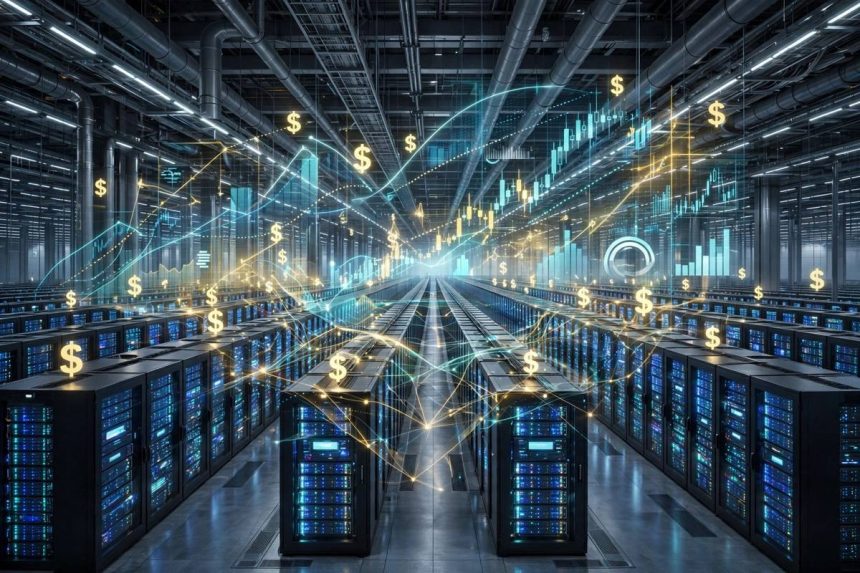
The artificial intelligence boom has produced some of the largest corporate spending plans in history. Technology companies are committing extraordinary sums to data centers, chips and power infrastructure, on the assumption that demand for AI services will grow into the capacity they are building. A growing number of analysts, however, are asking a blunt question: what if the revenue arrives more slowly than the bills? For stock investors, how that gap evolves may be one of the defining market stories of the next two years.
The Maths Behind the Concern
The scale of the build-out is difficult to overstate. Industry forecasts for AI infrastructure spending have climbed repeatedly, and recent analysis highlighted by The Register suggests the capital required to pay for planned data centers would demand an implausibly large pool of profitable work — by one estimate, the equivalent of hundreds of millions of jobs’ worth of economic value, in an economy that employs far fewer people than that. The comparison is deliberately provocative, but the underlying point is serious: forecast spending is being measured against expected revenue, and the two lines are moving apart, not together.
There is also a timing problem. Data centers are expensive to build, expensive to run and begin depreciating immediately. The chips inside them are superseded by faster generations within a few years. Revenue from AI subscriptions, cloud services and advertising, by contrast, is growing quickly but from a much smaller base. When spending is certain and revenue is projected, investors carry the risk that the projections disappoint.
Why Companies Keep Spending Anyway
If the maths looks uncomfortable, why do the largest technology firms keep raising their budgets? Partly because the strategic cost of falling behind appears greater than the financial cost of overbuilding. Each major platform company fears that a rival will control the infrastructure on which future AI services run. Partly, too, because the spending is genuinely supported by real demand: cloud backlogs are large, AI features are being built into products used by billions of people, and enterprise customers are signing long contracts.
There is precedent on both sides. The fibre-optic build-out of the late 1990s bankrupted many of its builders, yet the cheap capacity it left behind powered the next decade of internet growth — and the surviving owners did very well. Railways followed a similar pattern a century earlier. Infrastructure booms often end with the assets proving valuable, but not necessarily for the investors who paid the highest prices at the peak of enthusiasm.
What Investors Should Watch
The first signal is conversion: are AI capital budgets translating into disclosed AI revenue, and how fast? Companies increasingly break out cloud and AI growth in their results, and the trend in those lines matters more than headline spending announcements. Our recent guide to what experienced investors watch during earnings season explains how to read those disclosures beyond the headline numbers.
The second signal is funding. Spending financed from operating cash flow is very different from spending financed with growing piles of debt. Watch free cash flow, not just profits: a company can report rising earnings while its cash position deteriorates under the weight of construction. Rising borrowing by previously cash-rich firms is not automatically a red flag, but it changes the risk profile of their shares.
The third signal is pricing and utilisation. If data center capacity grows faster than demand, cloud prices fall, rental rates for computing power soften, and returns on the newest facilities disappoint. Conversely, sustained shortages and firm pricing would suggest demand is catching up with supply. Comments from chip suppliers, power companies and construction firms often reveal these shifts before they appear in the technology giants’ own results.
Positioning Without Guessing the Peak
Investors do not need to call the exact top of the AI cycle to manage this risk sensibly. Diversification remains the simplest protection: owning the theme through broad index funds rather than concentrating in a handful of the biggest spenders limits the damage if any single company has overcommitted. Position sizing matters too — the difference between a painful correction and a portfolio disaster is usually how much was riding on one story.
It also helps to separate the builders from the beneficiaries. Companies selling the picks and shovels — chips, power equipment, cooling and construction — earn revenue today from the spending itself. Companies building the data centers need future revenue to justify it. Both can perform well, but they carry different risks and deserve different valuations.
The Bottom Line
AI infrastructure spending outrunning revenue is not proof of a bubble, but it is a legitimate warning that expectations have run ahead of evidence. The technology is real, the demand is growing, and the strategic logic is understandable — yet none of that guarantees today’s spending earns an adequate return. Investors who track revenue conversion, cash flow and utilisation, and who keep position sizes honest, can stay exposed to one of the great growth stories of the decade without betting the portfolio on its most optimistic version.