

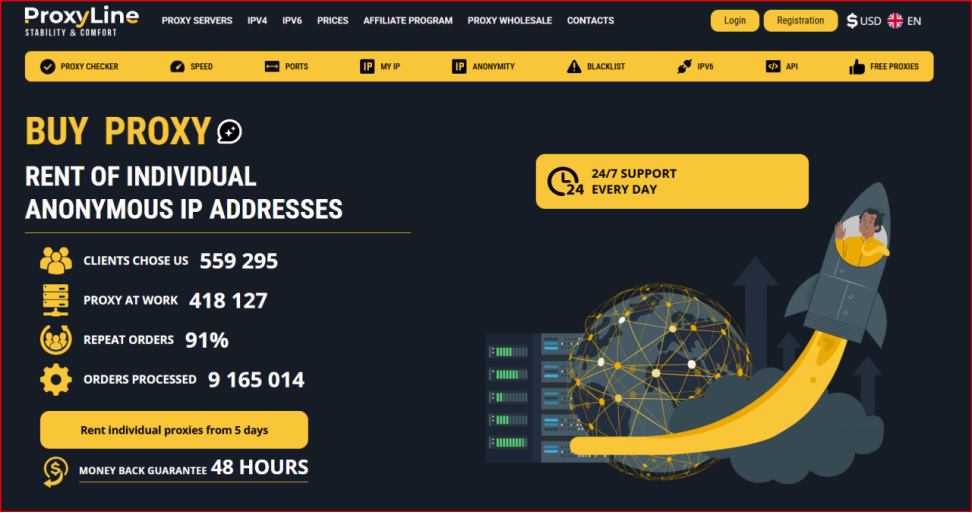
I reviewed ProxyLine as a change-control problem: what decisions does a buyer have to make from the first order through renewal, and what evidence should be recorded before each change? ProxyLine offers Shared IPv4, Individual IPv4, IPv6/32 and MTProto products, with short five-day rentals as well as longer 30-, 90- and 360-day terms. That catalog is simple enough to buy quickly, but the value of a fixed proxy comes from how carefully it is assigned, tested and renewed.
This review is therefore organized as a ledger of decisions. Instead of repeating a normal sequence of features, pros, use cases and conclusion, I treat each important operational choice as a checkpoint: which product to order, how much exclusivity matters, how to validate location, how to test the real destination, how to choose a protocol, how to document the endpoint, when to replace it, and when a longer rental actually saves money. The structure is especially useful for small teams that want predictable fixed proxies without turning a simple tool into a messy inventory problem.
| Review lens A fixed proxy is not just an IP address. It is an operational asset with an owner, target, protocol, expiry date and acceptance status. The review asks what should be decided and documented at each stage. |
Decision 1 – choose the product before the price
The first decision is not how cheap the proxy looks; it is what kind of network identity the workflow actually needs. Shared IPv4 is the lower-cost option when occasional reputation variance is acceptable. Individual IPv4 gives exclusive use during the rental period and is easier to map to a persistent browser profile, automation worker or client account. IPv6/32 is dramatically cheaper per address but only works when the entire client-to-target path supports IPv6. MTProto is a specialist Telegram-oriented product and should not be treated as a general-purpose substitute for HTTP or SOCKS5 proxying.
I would write the requirement in one sentence before opening checkout: for example, “one exclusive US IPv4 endpoint for a persistent browser profile” or “ten low-cost IPv6 addresses for a compatible test environment.” That sentence prevents a common buying mistake: selecting the cheapest line in the table and only later discovering that the protocol, address family or sharing model does not fit the task.
Decision 2 – use the rental term as a risk-control tool
The current ProxyLine pricing page shows the same core product families across several rental terms. The five-day option is especially useful because it creates a short validation period before a monthly or annual-style commitment.
| Product | Qty | 5 days | 30 days | 90 days | 360 days |
| IPv4 Shared | 1-20 IPs | $0.67 | $0.99 | $2.97 | $11.88 |
| Individual IPv4 | 1-20 IPs | $0.96 | $1.77 | $5.31 | $21.24 |
| Individual IPv4 | 21-40 IPs | $0.91 | $1.74 | $5.22 | $20.88 |
| Individual IPv4 | 41-89 IPs | $0.89 | $1.56 | $4.68 | $18.72 |
| Individual IPv4 | 90-1000 IPs | $0.83 | $1.50 | $4.50 | $18.00 |
| IPv6/32 | 1-99 IPs | $0.10 | $0.51 | $1.53 | $6.12 |
| IPv6/32 | 100-199 IPs | $0.10 | $0.48 | $1.44 | $5.76 |
| IPv6/32 | 200-3000 IPs | $0.09 | $0.48 | $1.44 | $5.76 |
| MTProto | 1-20 IPs | $0.96 | $1.77 | $5.31 | $21.24 |
For a first order, I prefer the shortest term that is long enough to test the real destination under normal working conditions. The 30-, 90- and 360-day options make more sense after the endpoint has already passed acceptance. The long term is not automatically the best value if a poor fit forces replacement, manual work or an abandoned workflow.
Decision 3 – define what “works” means
A proxy can be online and still fail the business requirement. I define acceptance with target-specific tests: the destination opens, the required regional content is shown, authentication works, the connection survives a restart, the required protocol works in the real client, and the endpoint does not immediately trigger a block that makes the workflow unusable. Generic speed tests are useful for diagnostics, but they are secondary to the actual destination.
| Acceptance item | Pass condition | Evidence to record |
| Connectivity | Endpoint connects in real client | Timestamp + client + protocol |
| Location | Target sees the required region | Observed country/city + checker result |
| Target access | Real destination behaves acceptably | Status, challenge or block notes |
| Persistence | Connection survives restart/reconnect | Second-session result |
| Assignment | Endpoint has one documented owner/task | Inventory label |
Decision 4 – shared or individual IPv4?
Shared IPv4 is not automatically low quality; it simply introduces another source of uncertainty because multiple customers may use the same address. That can be perfectly acceptable for public-page checks, localization QA, non-sensitive scraping or temporary research. Individual IPv4 reduces simultaneous sharing uncertainty and gives the buyer a clearer ownership model during the rental period. For persistent profiles, recurring automation or customer-facing workflows, that control is usually worth more than the price difference.
Exclusivity is not the same as a guarantee of perfect historical reputation. An address can still have prior history, and each destination evaluates reputation differently. I would therefore make the shared-vs-individual decision based on operational control and target sensitivity, not on the assumption that one category is universally clean and the other is universally risky.
Decision 5 – HTTP or SOCKS5?
Protocol choice should match the software. HTTP proxying is widely supported in browsers and libraries. SOCKS5 is more general and often fits desktop applications, automation tools and software that needs proxying below the HTTP layer. I would test the exact protocol used in production because a successful browser session does not prove that a separate command-line client, desktop app or automation runtime will behave identically.
Decision 6 – treat geolocation as data, not a label
The selected country is a starting point, not the final truth. Geo databases can disagree, city mappings can lag, and target websites can use their own location logic. I would validate each important endpoint with at least one independent checker and then confirm the behavior on the real destination. For local SEO, ad verification, ecommerce localization or region-specific QA, the destination result is more important than the label shown in a dashboard.
Decision 7 – build an inventory before scaling
One endpoint can live in memory; twenty cannot. Before increasing quantity, I would create an inventory with the proxy label, IP or hostname, country, protocol, assigned browser profile or job, purchase date, expiry date, acceptance status and last incident note. That simple record prevents duplicate assignment, forgotten renewals and the worst operational mistake: replacing a good endpoint because nobody remembers who was using it.
- Give each endpoint a stable internal label.
- Assign one owner or job whenever persistence matters.
- Record expiry before the first production use.
- Log replacements with a reason, not just a new IP.
- Keep credentials outside shared chat messages or public documents.
Decision 8 – replace only when the evidence supports it
Constant rotation can create more instability than it solves. I would replace an endpoint when repeated target-specific tests show a consistent block, the location is materially wrong, the connection is unstable, or the address cannot be used by the required client. A one-off CAPTCHA or a slower synthetic test is not automatically enough. The replacement rule should be written before incidents happen so the team does not react emotionally to every anomaly.
Decision 9 – evaluate total operating cost, not cents per IP
The visible price is only one component of cost. Manual replacement time, broken sessions, team confusion, failed regional checks and forgotten renewals can quickly cost more than the difference between Shared and Individual IPv4. For a professional workflow, the correct comparison is cost per usable endpoint and cost per successful task. The cheapest line in the pricing table wins only if it also keeps the operating process simple enough.
Decision 10 – renew the endpoint, not the habit
Renewal should be a deliberate approval. I would review target acceptance, recent incidents, whether the location requirement has changed, whether the task still needs a fixed endpoint, and whether a longer term now offers a real saving. If the proxy has passed a short pilot and become part of a stable workflow, longer rental terms can simplify operations. If the job is temporary, automatic renewal can quietly turn a cheap purchase into waste.
| Strengths | Limitations / checks |
| Short five-day rentals support low-risk testingClear product split across Shared IPv4, Individual IPv4, IPv6 and MTProtoFixed endpoints are easy to map to long-lived tasksHTTP/SOCKS5 support fits common toolsVolume and term pricing can reduce cost at scaleSimple catalog makes procurement easy to document | Destination acceptance must be tested per targetShared IPv4 adds reputation uncertaintyIndividual use does not guarantee perfect historyIPv6 requires end-to-end compatibilityFleet management still requires customer disciplineLive locations and checkout terms should be rechecked before large orders |
Final decision
ProxyLine is strongest when it is run like a controlled inventory rather than a disposable list of IPs. The combination of short rental terms, fixed endpoints and several product lanes makes it easy to test small, document what works and extend only the endpoints that pass. Before a new order or renewal, confirm current inventory and terms on the official English ProxyLine website. The best buying decision is the one that preserves operational clarity after the first week, not just the one with the lowest checkout total.
FAQ
What is the best first ProxyLine order?
Usually the smallest quantity and shortest term that can test the real target, location and software.
When is Shared IPv4 enough?
When occasional reputation variance is acceptable and the task is public, temporary or low risk.
Why choose Individual IPv4?
For exclusive use during the rental, clearer assignment and lower simultaneous-sharing uncertainty.
Should I buy IPv6 because it is cheaper?
Only after confirming the client, network path and destination all support IPv6.
What should I record before renewal?
Target acceptance, incidents, location accuracy, assignment, expiry and whether the task still needs the endpoint.