

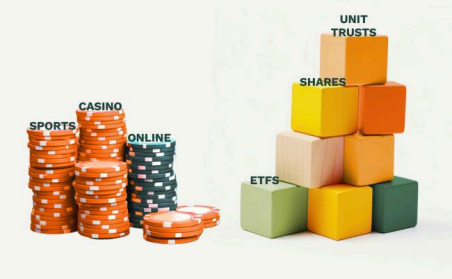
Some habits of the internet age would be funny if they weren’t so expensive. One of the strangest is the way people blur the line between entertainment and investing. A spinning reel, a fast payout, a win streak, a “system,” a lucky phase, and suddenly the language changes. It’s no longer just play, apparently. It’s “strategy.” It’s “capital rotation.” It’s “risk management.” That sort of talk usually ends where common sense should have started.
This confusion shows up a lot around products like online slots games, where speed, reward loops, and mobile convenience can create the illusion that repeated action equals financial method. It doesn’t. Slots are entertainment products built around random outcomes. Investing is a long-term financial activity built around ownership, value, and calculated exposure to risk. They are not cousins. They are not adjacent categories. They are fundamentally different things, even if both involve money and uncertainty.
That’s the core point of this article. Not moral panic. Not finger-wagging. Just a needed distinction, because too many people speak about online games and investing as if the only difference is branding. It isn’t.
Why people confuse the two in the first place
The mix-up doesn’t happen by accident. It comes from a few very modern habits.
First, people are now used to seeing everything through a financial lens. If time is being spent, someone wants to know the return. If money is moving, someone wants to frame it as a “play.” Add social media and things get worse. Wins are posted, losses are hidden, and every random good result starts looking like evidence of skill.
Second, digital products now share design language. Trading apps, gaming apps, sports apps, and entertainment platforms often look oddly similar. Bright dashboards. Real-time movement. charts. quick deposits. reward signals. That visual overlap encourages sloppy thinking.
Third, nobody likes admitting they’re just spending money for entertainment. For some reason, that feels less respectable than saying they’re “testing a strategy.” So language gets dressed up.
The problem is that dressed-up language can distort judgment.
Entertainment and investing serve different purposes
This sounds basic, but people need the reminder.
Online games exist to entertain. That includes slots, instant games, live formats, and most real-money gaming products. The point is engagement, excitement, short-term experience, and emotional payoff. The money involved is part of the structure, but it does not turn the activity into asset-building.
Investing serves a different purpose. It is meant to grow capital over time through exposure to assets that have underlying value or expected return potential. Stocks, bonds, ETFs, property funds, and similar instruments are connected to businesses, debt structures, economic output, or ownership claims.
That’s a completely different foundation.
Online games are built around chance and entertainment flow
The product is designed to be played.
Investments are built around value and long-term performance
The product is meant to be held, evaluated, and managed over time.
Once that distinction becomes clear, a lot of bad comparisons fall apart instantly.
Risk is not the same thing in both worlds
People often say, “Well, both involve risk.” True. But that sentence hides more than it reveals.
In investing, risk is tied to market movement, business performance, economic cycles, interest rates, political shocks, liquidity, valuation, and plain human error. It can be reduced, spread out, researched, and managed through diversification, time horizon, and discipline.
In online gaming, risk usually means something much simpler. The user may lose the stake. The outcome is determined by game mechanics and probability, not by the growth of a productive asset. There is no portfolio effect inside a slot spin. No compounding. No dividend. No ownership. Just exposure to an entertainment outcome.
That matters, because saying “both are risky” can make them sound more alike than they are. They’re not.
Why slots especially get misread
Slots are probably the easiest format to misunderstand financially because they are repetitive. Repetition creates a false sense of pattern. A player starts noticing sequences, dry spells, bonus rounds, near misses, stake changes, timing rituals. Suddenly every random event begins to feel part of a system.
This is where the investing language creeps in. People talk about “entry points,” “session bankroll,” “pulling back after volatility,” or “timing the machine.” It sounds clever. It also has almost nothing to do with actual investing.
A slot game does not increase in value because the player has studied it. It does not become a better financial instrument after ten sessions. It remains what it was at the start: a game of chance packaged for entertainment.
That doesn’t make it illegitimate. It just makes it something else.
Investing depends on information. Gaming often imitates that feeling
This is one of the more interesting overlaps.
Good investing relies on information that can be examined, challenged, and compared. Company earnings, debt levels, revenue growth, management quality, sector conditions, valuation, cash flow. None of this guarantees success, obviously, but the process is analytical.
Online games sometimes create a similar sensation without the same substance. The user gets dashboards, percentages, history, game stats, previous outcomes, animated trends, maybe a return-to-player figure. It feels data-rich. It feels like something can be decoded.
Usually, that feeling is stronger than the actual informational advantage available to the player. That’s not a criticism of the games. It’s a warning against reading them like markets.
Time horizon changes everything
This is one of the cleanest ways to separate investing from gaming.
Investing makes sense over time. It is not judged honestly over one afternoon, one lucky week, or one bad quarter. Long-term thinking is part of the structure. Patience is not optional.
Online games operate in the opposite rhythm. They are immediate. Session-based. Fast. Outcome-driven. The result lands now, not years from now. That immediacy is part of the appeal.
And that’s exactly why calling gaming “investment” is so misleading. One is built around deferred value. The other is built around immediate experience.
A person can enjoy both categories for what they are. Trouble begins when one starts pretending to be the other.
The emotional pattern is different too
Investing can be emotional, of course. Anyone who has watched a market crash knows that. But healthy investing tries to reduce emotional decisions. It rewards process, restraint, and consistency over time.
Online gaming often thrives on emotion in the moment. Excitement, suspense, frustration, anticipation, quick decisions, rapid reset. That’s not a bug. That’s part of the design.
This creates a practical issue. A person in an emotional loop may start making claims that sound financial while behaving in a purely reactive way. Chasing losses, increasing stakes, extending sessions, treating random wins as proof of a method. That’s not investing with a rough edge. That’s gaming behavior dressed up in investment language.
Useful questions to keep the difference clear
When money is involved, a few basic questions help cut through the fog: – Is there an underlying asset here?
– Does this activity create ownership or long-term value?
– Can the expected return be evaluated through business or market fundamentals? – Is the outcome mainly driven by chance in a short cycle?
– Would this still make sense if all the excitement were removed?
Those questions sound plain, maybe even obvious. Good. Obvious is underrated.
If the answer points toward entertainment, it should be treated as entertainment. That includes the budget, the mindset, and the expectations.
Why this distinction matters for regular users
Because language changes behavior.
A person who says, “This is part of my entertainment budget,” tends to think more clearly. Limits make sense. Losses are easier to frame. The activity stays in its lane.
A person who says, “This is an investment opportunity,” starts expecting recovery, logic, repeatability, and financial upside where none may really exist. That’s when bad habits harden. The same action suddenly feels justified, even when the evidence is thin or nonexistent.
For regular users, the benefit of clarity is simple:
– less self-deception
– better money boundaries
– lower chance of chasing losses under a fake “strategy”
– more realistic expectations
– healthier use of both investing tools and gaming products
That alone is worth separating the categories properly.
Can both exist in one person’s life?
Of course. Plenty of people invest responsibly and also spend money on games, sports, hobbies, or entertainment. There’s nothing contradictory about that.
The problem begins only when one category starts borrowing the language of the other. That’s usually a sign that someone is trying to make an impulsive activity sound more rational than it is.
A clean split works better.
Investing
Planned, researched, long-term, value-based.
Online gaming
Recreational, short-term, chance-based, budgeted.
That framework is not glamorous, but it prevents a lot of nonsense.
Final thoughts
Online games and investing may both involve money, uncertainty, and digital platforms, but that surface resemblance is exactly what trips people up. Underneath, they are built on completely different logic. One is entertainment. The other is capital allocation. One revolves around immediate outcomes and emotional engagement. The other, at its best, revolves around patience, value, and discipline.
That distinction is not old-fashioned. It’s necessary.
If people want to enjoy online games, fine. If they want to invest, also fine. But mixing the two usually leads to sloppy thinking, bad decisions, and a kind of self-justifying language that helps no one except the person trying not to admit what they’re actually doing.
And really, that’s the whole issue. Call things what they are. It saves money. It also saves a lot of pointless illusion.