

For this review, I tested ProxyStores for brand protection monitoring as the network layer for a legitimate brand-protection workflow: checking how public search pages, marketplace listings, reseller pages, and brand mentions appear in selected regions. I did not attempt to access private seller systems or evade enforcement controls. The purpose was to create repeatable regional evidence when a brand team receives a report that a misleading listing, unauthorized reseller, or counterfeit claim is visible in one country but difficult to reproduce from headquarters.
I structured every observation around evidence. The record included market, endpoint, source URL or search query, date and time, final URL, seller or publisher name when public, product title, price where visible, claim text, screenshot, and whether the result could be reproduced in a clean browser profile. This approach matters because brand-protection teams need defensible records, not just a screenshot with no network context.
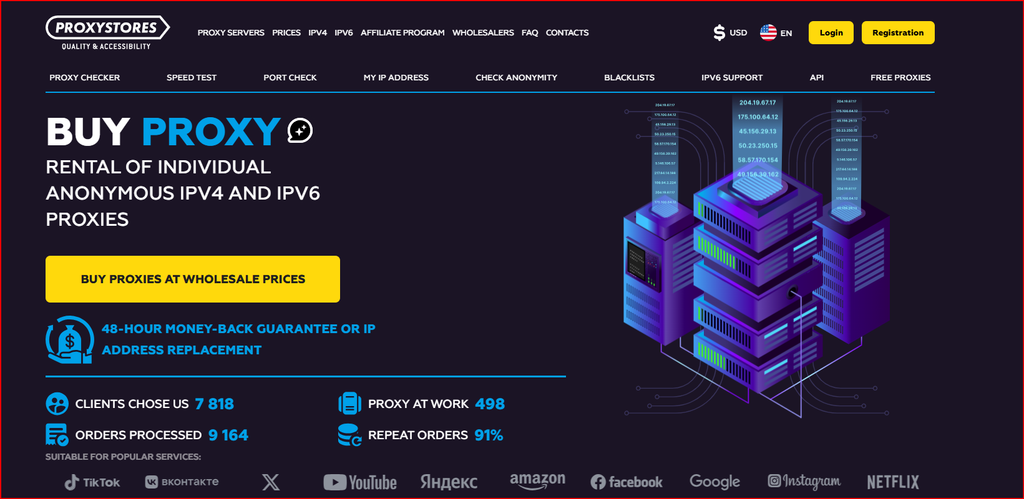
ProxyStores homepage screenshot used during this September 2026 brand-protection monitoring review.
How I Tested Regional Search Visibility
I started with branded queries and a short list of known public marketplaces or reseller pages. For each market I confirmed the visible IP location, used a clean profile, and captured the first page or public listing state without clicking through unnecessary flows. I recorded whether the same result appeared from a second market and whether the platform offered its own country selector. The proxy was used to reproduce a public view, not to impersonate a local account.
For suspicious results, I repeated the case with the same endpoint and again with a clean profile to reduce the chance that personalization or cached state created the difference. If the result disappeared, I marked it as non-reproducible rather than treating it as confirmed evidence.
Dedicated IPv4 for Evidence Reproduction
Individual IPv4 is useful when an investigator expects to revisit the same listing during an internal review or after sending a marketplace report. A stable endpoint does not guarantee that the platform will show identical search ranking, but it removes one source of network variation. Shared IPv4 can be sufficient for broad discovery where the team only needs to know whether a public page exists in a market.
I would keep endpoint labels in the case file together with the visible country, date, and browser state. That way, if a legal or marketplace team asks how the screenshot was obtained, the investigation has a clear and repeatable methodology rather than an undocumented “VPN test.”
Regional Price and Seller Claims
Brand-protection work often involves more than the existence of a listing. I recorded public price, currency, seller name, warranty language, “official” or “authorized” claims, and any location-specific shipping promise. A reseller may be legitimate in one territory and unauthorized in another, so the market context belongs in the evidence. I avoided making legal conclusions from the proxy test; it simply documents what the public page displayed.
If a result used the brand name in ad copy or metadata, I captured the exact text and final destination. For search ads or sponsored placements, a brand team should use the platform’s official reporting tools and legal guidance. The proxy can help reproduce the regional presentation, but it does not determine infringement.
IPv4 and IPv6 Coverage
ProxyStores offers both IPv4 and IPv6 products. IPv4 is the practical baseline because most marketplaces and public search services support it consistently. I use IPv6 only where the target and the research objective justify it. A different result on IPv6 is not automatically a brand-protection finding; it may reflect CDN routing, geolocation data, or abuse filtering.
When I do see a meaningful difference, I reproduce it with a second endpoint and record both network families separately. This keeps technical anomalies from being mixed with genuine regional content differences.
Search Hygiene and Low-Impact Testing
I keep brand-protection checks small and purposeful. Repeated automated searches can trigger platform defenses and also make the evidence less representative of a normal public view. For manual investigations I prefer a clean browser profile and a defined query list. For authorized automation, I would use low frequency, clear logging, and platform-compliant methods.
I also separate discovery from preservation. Discovery identifies a suspicious public result; preservation captures a screenshot, URL, time, market, and relevant text. The investigation file should then move to the brand, legal, or marketplace enforcement process instead of repeatedly hammering the same page.
Pricing Snapshot
The short rental terms make it inexpensive to build a small regional monitoring matrix. The figures below reflect the current lowest quantity bracket on the English pricing page. I would start with individual IPv4 in the most important territories and use shared or IPv6 coverage only where it adds clear value. Verify ProxyStores pricing before a larger monitoring cycle.
| Proxy type | 5 days | 30 days | 90 days | 360 days |
|---|---|---|---|---|
| IPv4 Shared | $0.67 | $0.99 | $2.97 | $11.88 |
| Individual IPv4 (1-20) | $0.96 | $1.77 | $5.31 | $21.24 |
| IPv6 /32 (1-99) | $0.10 | $0.51 | $1.53 | $6.12 |
| MTProto (1-20) | $0.96 | $1.77 | $5.31 | $21.24 |
What I Liked
The strongest fit is simple reproducibility. Fixed endpoints, short rental options, IPv4 and IPv6 products, and clear public pricing are useful when a brand team wants to document market-specific public content without purchasing a huge rotating pool. The workflow is easy to explain to non-technical reviewers because every screenshot can be tied to a labeled market and time.
I also like that the same method can support reseller policy checks, regional warranty wording, distributor pages, trademark usage, and market-specific search visibility. The proxy remains a network observation tool while the enforcement decision stays with the appropriate business or legal team.
What I Would Monitor
I would watch for personalization and account effects. Search and marketplace platforms may change rankings or content based on cookies, login state, language, device, and previous activity. A clean-profile reproduction should be the minimum standard before escalating a result. I would also maintain a short written methodology so different investigators collect comparable evidence.
Over time, I would focus on persistent patterns rather than one-off ranking changes. A suspicious listing that repeatedly appears in a market is more actionable than a transient result seen once. Stable endpoints help with that longitudinal evidence, but the case file still needs timestamps and screenshots because public platforms evolve.
FAQ
Q: Can a proxy prove that a seller is unauthorized? No. It can document what a public page displays in a region. Authorization and infringement require business or legal evidence.
Q: Is individual IPv4 better for monitoring? It is better for repeatable cases. Shared IPv4 is fine for broad discovery.
Q: Should I automate marketplace searches? Only where authorized and at low impact. Platform rules and official reporting tools should take priority.
Q: Is IPv6 necessary? Not always. Use it as a separate compatibility or coverage check where relevant.
Conclusion
After testing the workflow, I see ProxyStores as a practical option for small, repeatable brand-protection checks across regions. Its value is strongest when the investigation needs labeled network context and reproducible public evidence, not anonymous high-volume collection. I would confirm current products and locations on the ProxyStores English website before each monitoring cycle.