

Cancer research has traditionally focused on genetics. Scientists searched for mutations, damaged pathways, and abnormal proteins that could explain why tumors grow and spread. While genetics remains important, researchers now understand that cancer cells are shaped by something more dynamic: their environment.
One of the most important influences on cancer behavior is metabolism. The nutrients available to a tumor can directly affect how cancer cells think, behave, and survive. In many ways, metabolism acts like a form of biological memory. Nutrient conditions leave lasting marks on cancer cells, changing their identity through epigenetic regulation.
This growing field of research is reshaping how scientists understand tumor adaptation, treatment resistance, and cancer progression.
Cancer Cells Constantly Adapt to Their Environment
Healthy cells respond to nutrient levels in predictable ways. When nutrients are abundant, cells grow and divide. When nutrients are limited, cells slow down and conserve energy.
Cancer cells behave differently. Tumors often grow in environments with low oxygen, unstable blood supply, and fluctuating nutrient availability. To survive, cancer cells must constantly adapt.
This adaptation is not temporary. Over time, nutrient stress can permanently change how cancer cells function. Some cells become more aggressive. Others become resistant to therapy. Some even switch identity entirely.
Researchers are beginning to understand that metabolism does not just fuel cancer cells. It also rewrites the molecular instructions that control them.
How Metabolism Influences Epigenetics
Epigenetics refers to the systems that control which genes are turned on or off without changing the DNA sequence itself. These systems rely heavily on chemical tags that regulate gene activity.
What makes this process especially important is that many of these chemical reactions depend directly on nutrients and metabolic byproducts.
For example:
- Methylation reactions depend on molecules generated through nutrient metabolism
- Histone modifications rely on compounds like acetyl-CoA, which comes from glucose and fatty acid metabolism
- Cellular stress can alter chromatin structure and gene accessibility
This means that nutrient availability directly affects gene regulation.
When a cancer cell experiences metabolic stress, it may change its epigenetic programming to survive. These changes can remain stable long after the original stress has passed. In this way, metabolism creates a kind of cellular memory.
Nutrient Stress Can Change Cancer Cell Identity
One of the most fascinating discoveries in modern cancer biology is that cancer cells are more flexible than previously believed. They can shift between different states depending on environmental conditions.
In breast cancer, for example, luminal cells may transition into more basal-like states under treatment pressure or metabolic stress. These changes often involve epigenetic remodeling.
Chun Ju Chang, a breast cancer researcher at China Medical University, has studied how epigenetic regulators influence luminal identity and endocrine resistance. Her work highlights how changes in gene regulation can drive major shifts in cell behavior without requiring new genetic mutations.
Metabolic stress appears to play a role in this process. When nutrients become limited, cancer cells may silence genes associated with differentiation and activate survival programs instead. Over time, these changes can alter the entire identity of the tumor.
The Tumor Microenvironment Shapes Metabolic Behavior
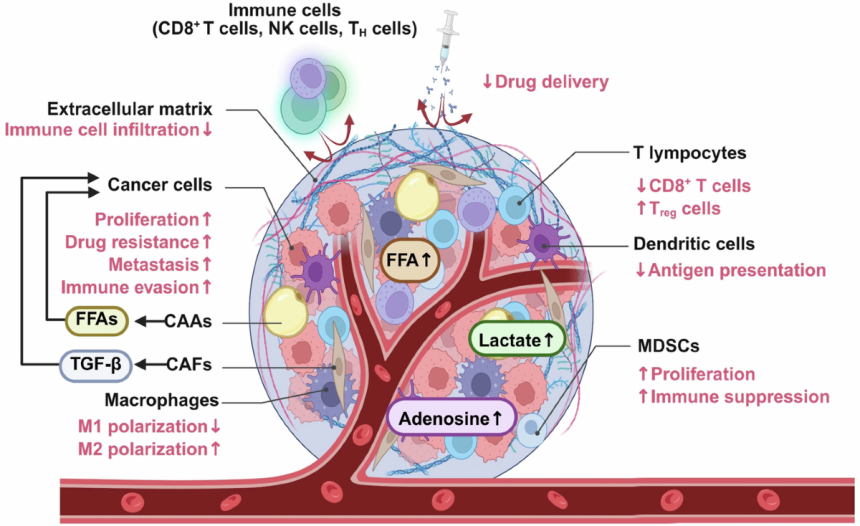
Cancer cells do not exist alone. They live within a complex microenvironment made up of immune cells, fibroblasts, blood vessels, and extracellular proteins. This environment strongly influences nutrient access.
Some regions of a tumor may receive plenty of oxygen and glucose. Other regions may experience severe deprivation. These differences create metabolic heterogenicity within the same tumor.
As a result, different groups of cancer cells may develop different epigenetic programs based on the nutrients available to them.
This diversity helps explain why tumors are so difficult to treat. Even if one group of cells responds to therapy, another group may survive because it adapted to a harsher metabolic environment earlier in the disease.
The tumor microenvironment is not just shaping metabolism. It is shaping identity.
Metabolism and Therapy Resistance
One of the biggest challenges in cancer treatment is resistance. Tumors often respond to therapy initially, then later return in a more aggressive form.
Metabolic adaptation is increasingly recognized as a major driver of this process.
When therapies target specific pathways, cancer cells often compensate by altering their metabolism. They may switch energy sources, change nutrient uptake, or activate stress-response programs.
These metabolic changes are closely tied to epigenetic remodeling. Together, they allow cancer cells to survive under pressure.
For example:
- Low glucose conditions may activate alternative survival programs
- Hypoxia can trigger epigenetic changes that promote invasion
- Nutrient scarcity may suppress differentiation genes and encourage plasticity
These adaptations can make tumors more resistant to chemotherapy, hormone therapy, and even immunotherapy.
Researchers now believe that successful treatment may require targeting both metabolism and epigenetic regulation at the same time.
Can Metabolic Conditions Be Manipulated Therapeutically?
One of the most exciting possibilities in this field is the idea of changing tumor behavior by altering metabolic conditions.
Scientists are exploring several approaches:
- Drugs that interfere with cancer metabolism
- Dietary interventions that influence nutrient availability
- Therapies targeting enzymes involved in epigenetic regulation
- Combination treatments that pair metabolic therapies with immunotherapy or endocrine therapy
The goal is not simply to starve cancer cells. It is to disrupt the metabolic signals that allow them to maintain aggressive identities.
If researchers can interrupt the connection between metabolism and epigenetic memory, they may be able to prevent tumors from adapting and becoming resistant.
Why This Changes How We Think About Cancer
For many years, cancer was viewed mainly as a genetic disease. Mutations were considered the central drivers of tumor behavior.
Today, the picture is more complex.
Cancer cells are shaped not only by their DNA but also by their environment, nutrient conditions, and metabolic history. These influences can leave lasting epigenetic marks that change how tumors behave.
This new understanding shifts the focus from static mutations to dynamic adaptation.
Chun Ju Chang and other researchers studying tumor plasticity have helped show that cancer identity is not fixed. Cells can change states in response to environmental pressures, and metabolism is one of the strongest pressures they face.
This perspective helps explain why tumors evolve so rapidly and why treatment resistance remains such a challenge.
Teaching the Next Generation to Think Dynamically
This evolving understanding of metabolism and epigenetics is also changing cancer research and education.
Students can no longer think of metabolism as simply energy production. They must understand it as a regulatory system that influences gene expression, immune interaction, lineage differentiation and cell fate.
Future scientists and physicians will need to think across disciplines. They will need to connect metabolism, epigenetics, immunology, developmental biology and clinical therapy into one integrated picture.
This systems-level thinking is essential for developing better cancer treatments.
Looking Ahead
The connection between metabolism and epigenetic memory represents one of the most exciting frontiers in cancer research. It helps explain how tumors adapt, why resistance develops, and how cancer cells change identity over time.
Most importantly, it offers new opportunities for intervention. By understanding how nutrient availability rewrites cancer cell behavior, researchers may eventually learn how to interrupt these processes before tumors become more aggressive or resistant.
Cancer cells remember the environments they survive in. The challenge now is learning how to erase or redirect those memories in ways that benefit patients.