

Creating an invoice might seem like a simple task, but in Switzerland, invoicing comes with specific legal and business requirements that entrepreneurs must follow. Whether you are a freelancer, startup owner, small business operator, or running a growing company, issuing professional and compliant invoices is essential for building trust and ensuring smooth payments. If you want a fast and reliable way to manage invoicing, you can explore Magic Heidi as a helpful solution for Swiss entrepreneurs.
A properly created Swiss invoice is not only important for accounting purposes but also helps your business maintain transparency, avoid disputes, and stay aligned with VAT regulations. Many small business owners face challenges when they start invoicing because they are unsure what details must be included, how to structure the invoice, and how to ensure compliance with Swiss standards.
This guide will walk you step-by-step through how to create a Swiss invoice correctly, what information you must include, and the best practices to make invoicing easier and more professional.
Why Swiss Invoices Must Follow Specific Standards
Switzerland has a highly organized financial system, and invoicing plays a major role in business documentation. If your invoices are missing key details, your clients may delay payments or reject them entirely. In addition, if you are VAT-registered, incorrect invoices may lead to compliance issues during audits.
Swiss invoices are used as:
Proof of transaction
Accounting documentation
VAT reporting evidenc
Payment request document
A professional invoice ensures your business appears credible, organized, and trustworthy.
Who Needs to Create Swiss Invoices?
Swiss invoicing rules apply to many different types of businesses, including
Freelancers and self-employed individuals
Small businesses (GmbH, AG, sole proprietorships)
Consultants and agencies
Online sellers and eCommerce companies
Service providers (cleaning, repair, coaching, etc.)
Construction and trade businesses
Even if your business is small, issuing invoices correctly is crucial from day one.
Essential Elements of a Swiss Invoice
To create a compliant Swiss invoice, you need to include certain mandatory information. While Swiss invoice formats can vary slightly depending on industry, the following elements are considered standard and expected in most cases.
1. Business Details (Seller Information)
Your invoice must clearly identify your business. This includes:
Company name
Address (street, postal code, city, country
Phone number or email address
Website (optional but professional)
VAT number (if registered)
Swiss clients expect invoices to look official and include complete business contact information.
2. Customer Details (Buyer Information)
Your client’s information should also appear on the invoice, including:
Customer name or company name
Customer address
VAT number (if applicable, especially B2B invoices)
This makes the invoice legally and professionally clear, and it avoids confusion in accounting.
3. Invoice Date
The invoice date is the date the invoice is issued. This is very important for:
Payment tracking
Accounting periods
VAT reporting
It should be displayed clearly, usually near the top of the invoice.
4. Unique Invoice Number
Every Swiss invoice must have a unique invoice number. This is one of the most important elements because it allows both you and your client to track payments and documentation.
Best practice is to use a structured invoice numbering system such as:
2026-001
INV-2026-015
CH-INV-00045
Make sure invoice numbers are not repeated.
5. Description of Products or Services
Your invoice should include a clear list of what you provided. This section should contain:
Service or product name
Short description (if needed)
Quantity (hours, units, etc.)
Price per unit
Total price per line
The clearer your service description, the fewer disputes you will face later.
Example:
| Description | Quantity | Unit Price | Total |
|---|---|---|---|
| Web design consultation | 5 hours | CHF 120 | CHF 600 |
6. Subtotal Amount
The subtotal is the total amount before VAT is applied. Even if you are not VAT-registered, showing a subtotal is still a good professional practice.
7. VAT Details (If Applicable)
If your business is VAT-registered in Switzerland, VAT must be clearly shown on the invoice.
Your invoice must include:
VAT rate (e.g., 7.7%, 2.5%, 3.8%)
VAT amount in CHF
Total including VAT
Your VAT number
If you are not VAT-registered, you should mention that VAT is not charged, for example:
“Not subject to VAT”
“VAT exempt”
“MWST nicht ausweisbar” (German version)
Swiss businesses often work with international clients, so it helps to clearly explain VAT status.
8. Total Amount Payable
The invoice must show the final total amount, including VAT (if applicable). This should be clearly visible and ideally highlighted or bolded.
Example:
Total Amount Due: CHF 1,250.00
9. Payment Terms and Due Date
Your invoice should specify when payment is expected. Standard Swiss payment terms often include:
Payable within 10 days
Payable within 30 days (common for B2B)
Payable immediately
You should also include the exact due date if possible.
Example:
Invoice date: 12.02.2026
Payment due: 14.03.2026
Clear payment terms help avoid late payments.
10. Payment Information (Bank or QR Payment)
In Switzerland, payment methods are extremely standardized. Your invoice should include:
IBAN number
Bank name
Account holder name
BIC/SWIFT (optional but helpful for international transfers)
Additionally, Swiss QR-bill (QR-Rechnung) is now widely used and preferred by many customers.
If you can provide QR-bill invoices, your clients will appreciate the convenience.
What Is a Swiss QR Invoice (QR-Bill)?
The Swiss QR invoice (also known as QR-bill or QR-Rechnung) is a modern invoicing format that includes a QR code. Clients can scan the QR code using their banking app and pay instantly without manually typing payment details.
A QR-bill typically contains:
QR code
Payment part
Reference number (optional)
Recipient details
Amount and currency (CHF/EUR)
For Swiss businesses, QR-bills are becoming a standard expectation.
Common Invoice Mistakes Swiss Businesses Should Avoid
Many entrepreneurs unintentionally make mistakes that delay payments or create accounting problems. Here are some common Swiss invoicing mistakes to avoid:
Missing Invoice Number
Without a unique invoice number, tracking becomes difficult and clients may reject the invoice.
Unclear Service Description
Clients need clarity. A vague line like “Consulting services” may cause questions.
Incorrect VAT Handling
Charging VAT without being registered, or forgetting to show VAT when required, can create compliance issues.
No Payment Terms
If you don’t include due dates, clients may pay whenever they want.
Not Using CHF Currency Clearly
Always mention CHF as the currency unless you invoice in EUR.
Lack of Professional Formatting
A poorly formatted invoice can reduce your credibility, especially when dealing with corporate clients.
Step-by-Step Guide to Creating a Swiss Invoice
Now let’s go through the process of creating a compliant Swiss invoice step by step.
Step 1: Add Your Business Identity
Start by placing your business name, address, and contact information at the top of the invoice.
This is usually placed on the left or top section.
Step 2: Insert Customer Information
Add your customer’s name and address. If your customer is a company, include the company name and department (if known).
Step 3: Create a Unique Invoice Number
Use a consistent numbering system. This helps you stay organized as your business grows.
Step 4: Mention the Invoice Date and Delivery Date
Add:
Invoice issue date
Delivery date (if different, especially for goods/services provided earlier)
This is especially important for VAT.
Step 5: List Products/Services Clearly
Create a table format for easy readability. Include:
Item/service name
Quantity
Unit price
Total price
If you provide multiple services, list them separately.
Step 6: Calculate Totals and VAT
Include:
Subtotal
VAT rate
VAT amount
Total payable
Swiss clients expect clear breakdowns.
Step 7: Add Payment Details
Include your IBAN and any additional banking details.
If you provide QR-bills, generate and attach the QR payment section.
Step 8: Add Payment Terms
Mention due date and late payment policies (if needed).
Example:
“Payment due within 30 days. Late payments may incur reminder fees.”
Step 9: Review Before Sending
Always double-check:
Customer name spelling
Invoice number
Total amount
VAT details
Correct IBAN
Even small errors can delay payments.
Best Practices for Swiss Invoicing
To make invoicing smooth and professional, follow these best practices.
Keep Your Invoice Design Simple
Swiss clients prefer clear and structured invoices over overly designed templates.
Use Professional Language
Write your invoice in the same language as your client (German, French, Italian, or English).
Offer Multiple Payment Options
While IBAN transfers are standard, QR payments are very convenient.
Send Invoices Quickly
Invoice soon after delivering the service. Delayed invoicing can cause delayed payments.
Keep Digital Records
Swiss accounting regulations require proper recordkeeping. Store invoices digitally for easy access.
Do You Need an Invoice Template in Switzerland?
Many entrepreneurs use invoice templates in Word or Excel. While templates can work for very small businesses, they often create problems such as:
Manual calculation errors
Difficulty tracking invoice numbers
Lack of automation
No payment reminders
No QR-bill generation
As your business grows, invoicing manually becomes time-consuming and risky.
That’s why many Swiss businesses move to invoicing software.
How Online Invoicing Tools Simplify Swiss Invoice Creation
Modern invoicing platforms can automate most of the invoicing process. This is especially useful for:
Freelancers sending regular invoices
Businesses with many customers
Companies that need VAT compliance
Entrepreneurs who want clean bookkeeping
With invoicing software, you can:
Generate invoices instantly
Automatically calculate VAT
Create QR invoices
Track payment status
Send reminders to clients
Export reports for accounting
This not only saves time but reduces costly mistakes.
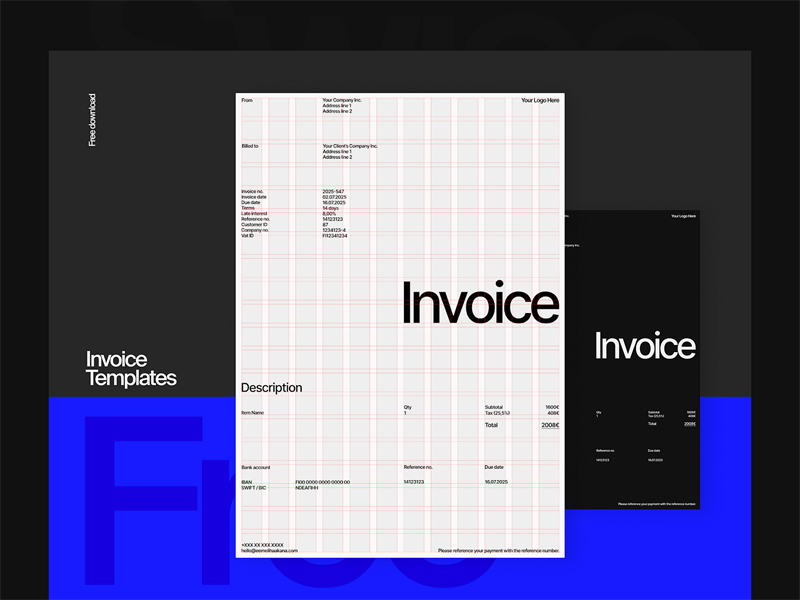
Swiss Invoice Example Structure (Simple Format)
Here is a simplified example of what a Swiss invoice should look like:
Invoice
Invoice Number: 2026-004
Invoice Date: 12.02.2026
Seller:
ABC Consulting GmbH
Bahnhofstrasse 10
8001 Zürich
Switzerland
VAT No: CHE-123.456.789 MWST
Customer:
XYZ Trading AG
Industriestrasse 5
4051 Basel
Switzerland
Description:
Consulting services (January 2026)
10 hours × CHF 120 = CHF 1,200
Subtotal: CHF 1,200
VAT (7.7%): CHF 92.40
Total Due: CHF 1,292.40
Payment Terms:
Due within 30 days
Bank Details:
IBAN: CHxx xxxx xxxx xxxx xxxx x
Account Holder: ABC Consulting GmbH
This is the basic structure, and it is accepted widely across Swiss business environments.
Do Swiss Invoices Need a Signature?
In most cases, Swiss invoices do not require a signature. However, some companies may request signed invoices or stamped documents depending on their internal accounting rules.
If you work with government agencies or larger corporations, it is always good to ask about their invoice requirements.
Should Swiss Invoices Be in German, French, or English?
Switzerland has multiple official languages. The best practice is:
Use German for German-speaking regions (Zurich, Bern, Basel, etc.)
Use French for French-speaking regions (Geneva, Lausanne, etc.)
Use Italian for Ticino
Use English for international clients or modern startups
Your invoice language should match your customer’s preference whenever possible.
How Long Should You Keep Swiss Invoices?
Swiss businesses are generally required to keep accounting records, including invoices, for several years. Keeping invoices safely stored is essential for:
Tax filing
VAT reporting
Audit compliance
Financial planning
Using cloud-based invoicing software makes recordkeeping much easier.
Conclusion
Creating a Swiss invoice is not difficult once you understand the essential requirements. A compliant invoice must include key details such as your business information, customer information, invoice number, service description, VAT details, and payment terms.
For entrepreneurs and small businesses in Switzerland, issuing invoices professionally helps build credibility and ensures clients pay faster. While templates can work initially, modern invoicing tools are a better long-term solution because they reduce errors and save time.
If you want to streamline the invoicing process and ensure your invoices meet Swiss standards, a solution like magicheidi.ch can help you create invoices quickly, manage payments, and keep your accounting organized.