

For this review, I tested SpaceProxy for travel fare research as a controlled way to compare public travel pages across markets. I did not automate bookings or try to bypass account restrictions. The goal was to see how a fixed regional viewpoint can support legitimate research into displayed currency, destination availability, language, taxes, fees, and public fare presentation for flights and hotels. Travel sites often combine IP location with language, cookies, account history, dates, device type, and inventory, so I treated the proxy as one variable in a larger test matrix.
I created repeatable cases with the same route or hotel, the same dates, the same browser language, and a clean session. For every market I recorded the visible country, currency, final URL, displayed base price, mandatory fee wording, taxes shown before checkout, and whether the property or itinerary appeared available. This produced a useful research log without assuming that a short public-page check represents a final transactional price.
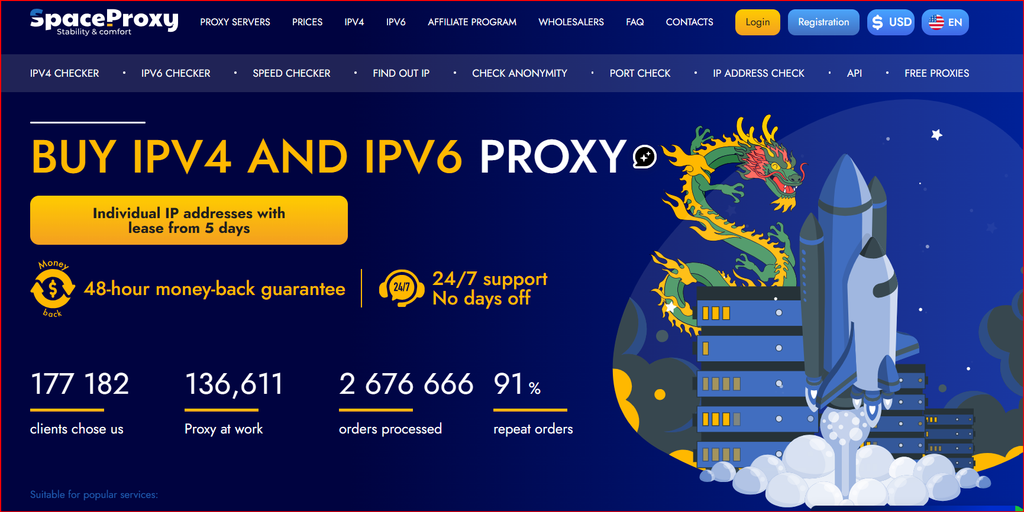
SpaceProxy homepage screenshot used during this September 2026 travel fare and availability review.
How I Built the Travel Test Matrix
I selected a few routes and hotel searches that were stable enough to repeat, then ran them from several labeled market endpoints. I avoided comparing searches hours apart when inventory could change materially. Each pass started with a clean profile and a time stamp. If a site allowed manual country or currency selection, I tested both the automatic state and the manually selected state because a well-designed site should let users understand and control regional presentation.
For flights, I captured the itinerary, fare family label, currency, taxes and fee disclosure, and final URL. For hotels, I captured room availability, nightly rate, total stay price when shown, tax wording, and any market-specific promotion. The purpose was not to prove discriminatory pricing; it was to identify where public presentation changes and where further business analysis is justified.
Availability vs Price
The first lesson is that availability and price must be logged separately. A hotel can be visible in one market but not another because of distribution agreements, while a flight can have the same inventory but a different currency display. I created separate result fields for “available,” “price displayed,” “currency,” “tax wording,” and “promotion.” That prevents a missing listing from being misreported as a price difference.
I also recorded whether the site was using a market-specific domain, language subfolder, or account setting. When the same browser manually changed country, I noted whether that choice overrode the IP-derived market. This is important because many travel platforms intentionally let the user select a country even when their network location suggests something else.
Individual vs Shared IPv4
For repeated fare research, individual IPv4 is easier to document because the endpoint stays associated with one customer during the rental term. Shared IPv4 can still work for quick public-page comparisons where long-term reproducibility is less important. I would reserve dedicated endpoints for markets that produce a meaningful difference or where a research team expects to rerun the same case over several days.
A fixed proxy does not freeze airline or hotel inventory. Even with the same endpoint, prices can change because inventory, time, cookies, demand, and promotions change. That is why the research log needs timestamps and identical search criteria. The proxy improves network consistency; it does not make a dynamic travel marketplace static.
IPv6 and Network Compatibility
SpaceProxy offers IPv6, which is useful as a compatibility path when the travel site and its CDN support dual stack. I would not compare an IPv4 result directly with an IPv6 result and assume any difference is pricing strategy. The route, CDN edge, geolocation data, or anti-abuse system can behave differently. I record IPv6 as a separate test dimension.
If the user-facing result is materially different on IPv6, the next step is to reproduce it with a second endpoint and inspect the technical response before drawing a commercial conclusion. This keeps the research grounded and reduces false positives caused by network differences.
Browser Profiles, Cookies and Currency
Travel research is sensitive to state. I start with a clean browser profile, then intentionally repeat selected searches with cookies preserved. If the site remembers currency or market selection, that behavior is part of the finding. I also separate browser language from proxy location, because a French-language browser from a US endpoint can produce a different page than an English-language browser from the same endpoint.
I would never use hidden automation to generate artificial searches at scale. A small, well-documented matrix is more useful for market research and QA than a high-volume process that triggers rate limits and makes results harder to interpret.
Pricing Snapshot
The published rental terms are flexible enough for short research projects. A five-day window can cover a focused market comparison, while longer terms suit recurring QA. The table below reflects the current low-quantity English pricing snapshot. Because country, quantity, and duration can change the unit cost, verify SpaceProxy pricing before ordering.
| Proxy type | 5 days | 30 days | 90 days | 360 days |
|---|---|---|---|---|
| IPv4 Shared | $0.67 | $0.99 | $2.97 | $11.88 |
| Individual IPv4 (1-20) | $0.96 | $1.77 | $5.31 | $21.24 |
| IPv6 /32 (1-99) | $0.10 | $0.51 | $1.53 | $6.12 |
What I Liked
The strongest fit is straightforward regional comparison without requiring a large rotating pool. Fixed endpoints, short rental options, IPv4 and IPv6 products, and conventional proxy formats are practical for a researcher who wants a small number of stable market viewpoints. The cost structure also makes it easy to test the method before expanding to more countries.
I also like that the workflow can support both travel research and quality assurance. Currency selectors, translated copy, tax labels, availability notices, and market-specific promotions can all be checked while the same test record preserves the route or property, dates, and network context.
What I Would Monitor
I would monitor timing very carefully. Travel inventory changes quickly, so cross-market comparisons should be run close together and repeated before a conclusion is published. I would also record whether the user was logged in, whether loyalty pricing applied, and whether any coupon or member rate was visible. Those factors can easily create a false story about geo pricing.
Over a longer project I would maintain a small baseline set of routes and hotels and rerun them on a schedule. The objective is not to chase every price change; it is to identify consistent regional presentation patterns. Any unusual result should be reproduced with a clean session and, ideally, a second endpoint.
FAQ
Q: Does a proxy reveal the final checkout price? Not necessarily. Taxes, fees, account state, and payment method can change later. Treat public-page results as research evidence, not a guaranteed final fare.
Q: Should I use shared or individual IPv4? Individual is better for repeatable research. Shared is fine for broad spot checks.
Q: Can I compare IPv4 and IPv6 prices directly? Treat them as separate network tests first. Reproduce any difference before assigning a commercial cause.
Q: Can I automate travel checks? Only where authorized and at conservative rates. Avoid creating artificial bookings or interfering with inventory.
Conclusion
After testing the workflow, I see SpaceProxy as a useful network layer for careful travel fare and availability research where the team needs stable regional viewpoints at a predictable cost. The strongest results come from disciplined logging and close timing, not from high request volume. I would confirm current locations and terms on the SpaceProxy English website before starting a new market study.